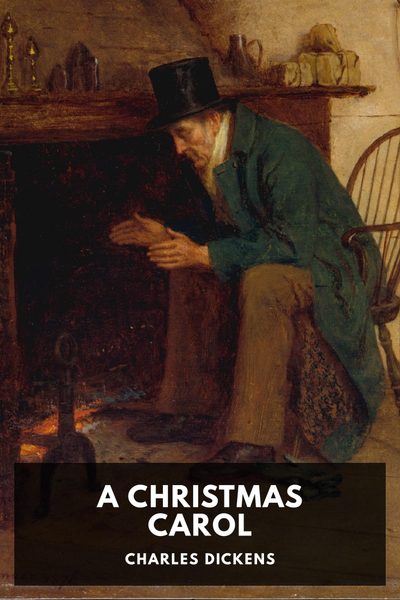
Cuento de Navidad en inglés: ¿qué nivel necesitas? (B2)
Cuento de Navidad, Charles Dickens, 1843
- Palabras
- 28.721
- Palabras distintas
- 3568
- Palabras poco frecuentes
- 13%
- Horas de lectura
- 2.4
Espera una palabra nueva en casi cada párrafo.
Es bastante difícil. Calculamos Cuento de Navidad en el nivel B2: el 13% de sus 28.721 palabras queda fuera de las 3000 más comunes, así que verás una palabra nueva en casi cada párrafo. Se lee en unas 2.4 horas.
A quién le va bien
Lectores de nivel B2 que terminan novelas más sencillas sin problema y quieren ampliar vocabulario. Léelo en sesiones cortas cada día.
Un libro corto que se lee en unas pocas noches. Dickens escribe frases largas y rítmicas, llenas de descripción, y el narrador se dirige directamente al lector. Los diálogos son más fáciles, sobre todo los de Scrooge. Encontrarás palabras como phantom, spectre, scarcely y pudding, y algunas expresiones victorianas. La historia es tan conocida que rara vez pierdes el hilo.
Palabras poco frecuentes que vuelven una y otra vez
- bob53
- ha24
- phantom17
- niece13
- self12
- spectre12
- em11
- pudding11
- scarcely11
- goose10
- grind10
- conduct9
- humbug9
- robe9
- turkey9
- plump8
- baker7
- cheerful7
- darkness7
- endeavour7
Verbos con partícula que te vas a encontrar
- sit down10
- come in5
- go on5
- listen to5
- come back4
- shut up4
- go down3
- make up3
- put on3
- put out3
- set up3
- come on2
- come out2
- get out2
- get over2
Cómo empieza
Marley’s Ghost
Marley was dead, to begin with. There is no doubt whatever about that. The register of his burial was signed by the clergyman, the clerk, the undertaker, and the chief mourner. Scrooge signed it. And Scrooge’s name was good upon ’Change for anything he chose to put his hand to. Old Marley was as dead as a doornail.
Mind! I don’t mean to say that I know of my own knowledge, what there is particularly dead about a doornail. I might have been inclined, myself, to regard a coffin nail as the deadest piece of ironmongery in the trade. But the wisdom of our ancestors is in the simile; and my unhallowed hands shall not disturb it, or the country’s done for. You will, therefore, permit me to repeat, emphatically, that Marley was as dead as a doornail.
Scrooge knew he was dead? Of course he did. How could it be otherwise? Scrooge and he were partners for I don’t know how many years. Scrooge was his sole executor, his sole administrator, his sole assign, his sole residuary legatee, his sole friend, and sole mourner. And even Scrooge was not so dreadfully cut up by the sad event but that he was an excellent man of business on the very day of the funeral, and solemnised it with an undoubted bargain.
The mention of Marley’s funeral brings me back to the point I started from. There is no doubt that Marley was dead. This must be distinctly understood, or nothing wonderful can come of the story I am going to relate. If we were not perfectly convinced that Hamlet’s father died before the play began, there would be nothing more remarkable in his taking a stroll at night, in an easterly wind, upon his own ramparts, than there would be in any other middle-aged gentleman rashly turning out after dark in a breezy spot —say St. Paul’s Churchyard, for instance —literally to astonish his son’s weak mind.
Scrooge never painted out Old Marley’s name. There it stood, years afterwards, above the warehouse door: Scrooge and Marley. The firm was known as Scrooge and Marley. Sometimes people new to the business called Scrooge Scrooge, and sometimes Marley, but he answered to both names. It was all the same to him.
Oh! but he was a tight-fisted hand at the grindstone, Scrooge! a squeezing, wrenching, grasping, scraping, clutching, covetous old sinner! Hard and sharp as flint, from which no steel had ever struck out generous fire; secret, and self-contained, and solitary as an oyster. The cold within him froze his old features, nipped his pointed nose, shrivelled his cheek, stiffened his gait; made his eyes red, his thin lips blue; and spoke out shrewdly in his grating voice. A frosty rime was on his head, and on his eyebrows, and his wiry chin. He carried his own low temperature always about with him; he iced his office in the dog-days, and didn’t thaw it one degree at Christmas.
External heat and cold had little influence on Scrooge. No warmth could warm, no wintry weather chill him. No wind that blew was bitterer than he, no falling snow was more intent upon its purpose, no pelting rain less open to entreaty. Foul weather didn’t know where to have him. The heaviest rain, and snow, and hail, and sleet could boast of the advantage over him in only one respect.
Preguntas frecuentes
¿Sirve Cuento de Navidad para aprender inglés?
Sí, a partir de B2. Por debajo se hará lento.
¿Qué nivel de inglés necesito para leer Cuento de Navidad?
Más o menos B2. Es nuestra estimación solo por vocabulario: contamos las palabras fuera de las 3000 más comunes y no medimos la longitud de las frases ni el estilo antiguo.
¿Cuánto se tarda en leer Cuento de Navidad?
28.721 palabras, unas 2.4 horas a una velocidad media de lectura. A 20 minutos al día son unos 8 días.