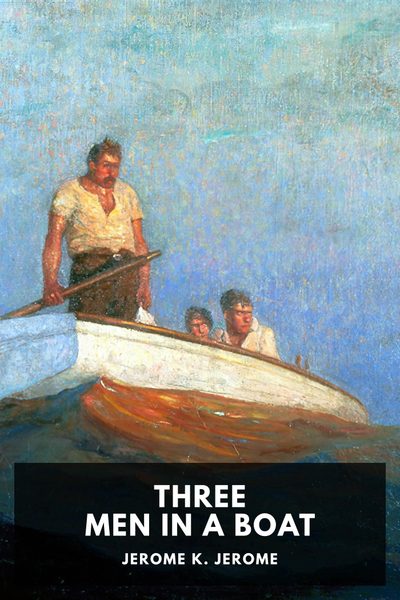
Tres hombres en un bote en inglés: ¿qué nivel necesitas? (B2)
Tres hombres en un bote, Jerome K. Jerome, 1889
- Palabras
- 67.225
- Palabras distintas
- 5142
- Palabras poco frecuentes
- 11%
- Palabras por frase
- 20.1
- Horas de lectura
- 5.6
Espera una palabra nueva en casi cada párrafo.
Es bastante difícil. Calculamos Tres hombres en un bote en el nivel B2: el 11% de sus 67.225 palabras queda fuera de las 3000 más comunes, las frases tienen de media 20.1 palabras, así que verás una palabra nueva en casi cada párrafo. Se lee en unas 5.6 horas.
A quién le va bien
Lectores de nivel B2 que terminan novelas más sencillas sin problema y quieren ampliar vocabulario. Léelo en sesiones cortas cada día.
Un relato cómico sobre tres amigos y un perro en un viaje en bote por el Támesis. Las frases son fáciles, pero el humor depende de la exageración y del argot británico, así que algunos chistes piden una segunda lectura. Las palabras poco frecuentes tratan de barcas y viajes: scull, tow, punt, hamper, towline. Los episodios son casi independientes, lo que facilita leer en sesiones cortas.
Palabras poco frecuentes que vuelven una y otra vez
- scull35
- tow30
- pie22
- hamper21
- punt18
- towline18
- comic17
- hotel17
- tomb16
- goes15
- opposite15
- steer15
- trout15
- canvas14
- stroke14
- anybody13
- funny13
- steadily13
- thirty13
- abbey12
Verbos con partícula que te vas a encontrar
- go on31
- get up29
- get out25
- sit down23
- get in18
- come in16
- come back15
- come out15
- go in15
- look at15
- go out14
- put up14
- give up13
- go for12
- come up11
Cómo empieza
Three invalids —Sufferings of George and Harris —A victim to one hundred and seven fatal maladies —Useful prescriptions —Cure for liver complaint in children —We agree that we are overworked, and need rest —A week on the rolling deep? —George suggests the River —Montmorency lodges an objection —Original motion carried by majority of three to one.
There were four of us —George, and William Samuel Harris, and myself, and Montmorency. We were sitting in my room, smoking, and talking about how bad we were —bad from a medical point of view I mean, of course.
We were all feeling seedy, and we were getting quite nervous about it. Harris said he felt such extraordinary fits of giddiness come over him at times, that he hardly knew what he was doing; and then George said that he had fits of giddiness too, and hardly knew what he was doing. With me, it was my liver that was out of order. I knew it was my liver that was out of order, because I had just been reading a patent liver-pill circular, in which were detailed the various symptoms by which a man could tell when his liver was out of order. I had them all.
It is a most extraordinary thing, but I never read a patent medicine advertisement without being impelled to the conclusion that I am suffering from the particular disease therein dealt with in its most virulent form. The diagnosis seems in every case to correspond exactly with all the sensations that I have ever felt.
I remember going to the British Museum one day to read up the treatment for some slight ailment of which I had a touch —hay fever, I fancy it was. I got down the book, and read all I came to read; and then, in an unthinking moment, I idly turned the leaves, and began to indolently study diseases, generally. I forget which was the first distemper I plunged into —some fearful, devastating scourge, I know —and, before I had glanced half down the list of “premonitory symptoms,” it was borne in upon me that I had fairly got it.
I sat for awhile, frozen with horror; and then, in the listlessness of despair, I again turned over the pages. I came to typhoid fever —read the symptoms —discovered that I had typhoid fever, must have had it for months without knowing it —wondered what else I had got; turned up St. Vitus’s Dance —found, as I expected, that I had that too —began to get interested in my case, and determined to sift it to the bottom, and so started alphabetically —read up ague, and learnt that I was sickening for it, and that the acute stage would commence in about another fortnight. Bright’s disease, I was relieved to find, I had only in a modified form, and, so far as that was concerned, I might live for years. Cholera I had, with severe complications; and diphtheria I seemed to have been born with. I plodded conscientiously through the twenty-six letters, and the only malady I could conclude I had not got was housemaid’s knee.
I felt rather hurt about this at first; it seemed somehow to be a sort of slight. Why hadn’t I got housemaid’s knee? Why this invidious reservation? After a while, however, less grasping feelings prevailed. I reflected that I had every other known malady in the pharmacology, and I grew less selfish, and determined to do without housemaid’s knee.
Preguntas frecuentes
¿Sirve Tres hombres en un bote para aprender inglés?
Sí, a partir de B2. Por debajo se hará lento.
¿Qué nivel de inglés necesito para leer Tres hombres en un bote?
Más o menos B2. Es nuestra estimación a partir de dos cosas: la proporción de palabras fuera de las 3000 más comunes y la longitud media de las frases (20.1 palabras aquí). No medimos el estilo antiguo.
¿Cuánto se tarda en leer Tres hombres en un bote?
67.225 palabras, unas 5.6 horas a una velocidad media de lectura. A 20 minutos al día son unos 17 días.
Libros parecidos
- Secuestrado, B2
- Grandes esperanzas, B2
- Orgullo y prejuicio, B2