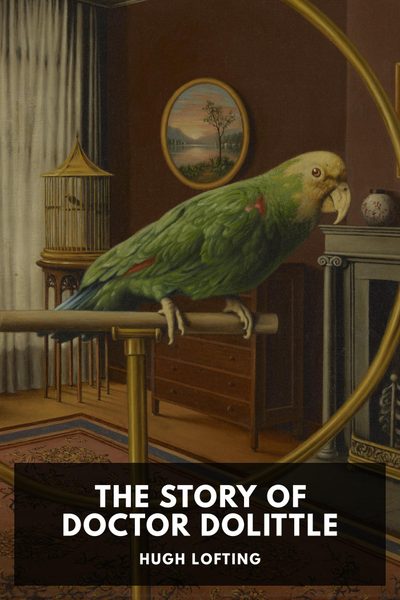
Povestea doctorului Dolittle în engleză: ce nivel îți trebuie (A1)
Povestea doctorului Dolittle, Hugh Lofting, 1920
- Cuvinte
- 25.469
- Cuvinte diferite
- 2.045
- Cuvinte rare
- 8%
- Ore de citit
- 2.1
Foarte puține cuvinte rare pentru o carte întreagă. Cel mai ușor tip de text real.
Nu, Povestea doctorului Dolittle nu e grea. E o lectură ușoară la nivelul A1: doar 8% din cele 25.469 de cuvinte sunt în afara celor mai frecvente 3.000, iar cartea se citește în circa 2.1 ore.
Cui i se potrivește
Cititorilor de nivel A1–A2 care vor prima carte adevărată în engleză și nu se supără să caute un cuvânt din când în când.
Capitole scurte și un narator prietenos, care explică lucrurile simplu. Propozițiile sunt scurte, iar acțiunea se urmărește ușor. Cuvintele rare sunt mai ales animale și termeni de navigație: monkey, pirate, parrot, jungle. Autorul repetă des ideile, așa că cuvintele noi se ghicesc ușor. Unele expresii din anii 1920 sună demodat, dar nu încurcă lectura.
Cuvinte rare care se repetă
- monkey67
- pirate38
- parrot35
- jungle22
- pullyu21
- pushmi21
- sailor17
- owl16
- rat16
- snuff16
- crocodile13
- presently13
- anchor12
- shark12
- farmer11
- terribly10
- canary9
- drowned9
- grind9
- meatman9
Verbe frazale pe care le vei întâlni
- go back17
- come back16
- go on10
- come down9
- get back8
- look for8
- come up7
- get out7
- go down7
- look at7
- give up6
- go away6
- come in5
- get on5
- get up5
Cum începe
Puddleby
Once upon a time, many years ago —when our grandfathers were little children —there was a doctor; and his name was Dolittle —John Dolittle, M.D. “M.D.” means that he was a proper doctor and knew a whole lot.
He lived in a little town called, Puddleby-on-the-Marsh. All the folks, young and old, knew him well by sight. And whenever he walked down the street in his high hat everyone would say, “There goes the Doctor! —He’s a clever man.” And the dogs and the children would all run up and follow behind him; and even the crows that lived in the church-tower would caw and nod their heads.
The house he lived in, on the edge of the town, was quite small; but his garden was very large and had a wide lawn and stone seats and weeping-willows hanging over. His sister, Sarah Dolittle, was housekeeper for him; but the Doctor looked after the garden himself.
He was very fond of animals and kept many kinds of pets. Besides the goldfish in the pond at the bottom of his garden, he had rabbits in the pantry, white mice in his piano, a squirrel in the linen closet and a hedgehog in the cellar. He had a cow with a calf too, and an old lame horse —twenty-five years of age —and chickens, and pigeons, and two lambs, and many other animals. But his favorite pets were Dab-Dab the duck, Jip the dog, Gub-Gub the baby pig, Polynesia the parrot, and the owl Too-Too.
His sister used to grumble about all these animals and said they made the house untidy. And one day when an old lady with rheumatism came to see the Doctor, she sat on the hedgehog who was sleeping on the sofa and never came to see him any more, but drove every Saturday all the way to Oxenthorpe, another town ten miles off, to see a different doctor.
Then his sister, Sarah Dolittle, came to him and said,
“John, how can you expect sick people to come and see you when you keep all these animals in the house? It’s a fine doctor would have his parlor full of hedgehogs and mice! That’s the fourth personage these animals have driven away. Squire Jenkins and the Parson say they wouldn’t come near your house again —no matter how sick they are. We are getting poorer every day. If you go on like this, none of the best people will have you for a doctor.”
“But I like the animals better than the ‘best people,’ ” said the Doctor.
“You are ridiculous,” said his sister, and walked out of the room.
So, as time went on, the Doctor got more and more animals; and the people who came to see him got less and less. Till at last he had no one left —except the Cat’s-meatman, who didn’t mind any kind of animals. But the Cat’s-meatman wasn’t very rich and he only got sick once a year —at Christmas-time, when he used to give the Doctor sixpence for a bottle of medicine.
Sixpence a year wasn’t enough to live on —even in those days, long ago; and if the Doctor hadn’t had some money saved up in his money-box, no one knows what would have happened.
And he kept on getting still more pets; and of course it cost a lot to feed them. And the money he had saved up grew littler and littler.
Then he sold his piano, and let the mice live in a bureau-drawer. But the money he got for that too began to go, so he sold the brown suit he wore on Sundays and went on becoming poorer and poorer.
Întrebări frecvente
Merită Povestea doctorului Dolittle pentru cei care învață engleza?
Da. Are puține cuvinte rare, deci e o primă carte blândă.
Ce nivel de engleză îți trebuie pentru Povestea doctorului Dolittle?
Cam A1. E estimarea noastră doar din vocabular: numărăm cuvintele din afara celor mai frecvente 3.000 și nu măsurăm lungimea propozițiilor sau stilul vechi.
Cât timp îți ia să citești Povestea doctorului Dolittle?
25.469 de cuvinte, circa 2.1 ore la o viteză medie de citit. La 20 de minute pe zi înseamnă circa 7 zile.