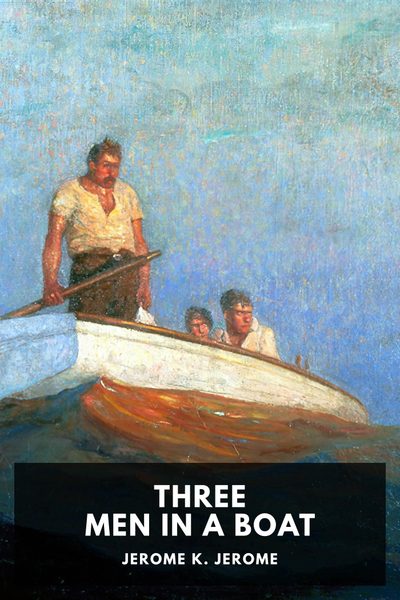
Trei într-o barcă în engleză: ce nivel îți trebuie (B2)
Trei într-o barcă, Jerome K. Jerome, 1889
- Cuvinte
- 67.225
- Cuvinte diferite
- 5.142
- Cuvinte rare
- 11%
- Cuvinte pe propoziție
- 20.1
- Ore de citit
- 5.6
Te aștepți la un cuvânt nou în aproape fiecare paragraf.
E destul de grea. Estimăm Trei într-o barcă la nivelul B2: 11% din cele 67.225 de cuvinte sunt în afara celor mai frecvente 3.000, propozițiile au în medie 20.1 cuvinte, deci vei întâlni un cuvânt nou în aproape fiecare paragraf. Se citește în circa 5.6 ore.
Cui i se potrivește
Cititorilor de nivel B2 care termină ușor romane mai simple și vor să-și lărgească vocabularul. Citește-o în sesiuni scurte, zilnic.
O relatare comică despre trei prieteni și un câine într-o excursie cu barca pe Tamisa. Propozițiile sunt ușoare, dar umorul se bazează pe exagerare și pe argou britanic, așa că unele glume cer o a doua citire. Cuvintele rare țin de bărci și de călătorie: scull, tow, punt, hamper, towline. Episoadele sunt în mare parte independente, deci se citește ușor în sesiuni scurte.
Cuvinte rare care se repetă
- scull35
- tow30
- pie22
- hamper21
- punt18
- towline18
- comic17
- hotel17
- tomb16
- goes15
- opposite15
- steer15
- trout15
- canvas14
- stroke14
- anybody13
- funny13
- steadily13
- thirty13
- abbey12
Verbe frazale pe care le vei întâlni
- go on31
- get up29
- get out25
- sit down23
- get in18
- come in16
- come back15
- come out15
- go in15
- look at15
- go out14
- put up14
- give up13
- go for12
- come up11
Cum începe
Three invalids —Sufferings of George and Harris —A victim to one hundred and seven fatal maladies —Useful prescriptions —Cure for liver complaint in children —We agree that we are overworked, and need rest —A week on the rolling deep? —George suggests the River —Montmorency lodges an objection —Original motion carried by majority of three to one.
There were four of us —George, and William Samuel Harris, and myself, and Montmorency. We were sitting in my room, smoking, and talking about how bad we were —bad from a medical point of view I mean, of course.
We were all feeling seedy, and we were getting quite nervous about it. Harris said he felt such extraordinary fits of giddiness come over him at times, that he hardly knew what he was doing; and then George said that he had fits of giddiness too, and hardly knew what he was doing. With me, it was my liver that was out of order. I knew it was my liver that was out of order, because I had just been reading a patent liver-pill circular, in which were detailed the various symptoms by which a man could tell when his liver was out of order. I had them all.
It is a most extraordinary thing, but I never read a patent medicine advertisement without being impelled to the conclusion that I am suffering from the particular disease therein dealt with in its most virulent form. The diagnosis seems in every case to correspond exactly with all the sensations that I have ever felt.
I remember going to the British Museum one day to read up the treatment for some slight ailment of which I had a touch —hay fever, I fancy it was. I got down the book, and read all I came to read; and then, in an unthinking moment, I idly turned the leaves, and began to indolently study diseases, generally. I forget which was the first distemper I plunged into —some fearful, devastating scourge, I know —and, before I had glanced half down the list of “premonitory symptoms,” it was borne in upon me that I had fairly got it.
I sat for awhile, frozen with horror; and then, in the listlessness of despair, I again turned over the pages. I came to typhoid fever —read the symptoms —discovered that I had typhoid fever, must have had it for months without knowing it —wondered what else I had got; turned up St. Vitus’s Dance —found, as I expected, that I had that too —began to get interested in my case, and determined to sift it to the bottom, and so started alphabetically —read up ague, and learnt that I was sickening for it, and that the acute stage would commence in about another fortnight. Bright’s disease, I was relieved to find, I had only in a modified form, and, so far as that was concerned, I might live for years. Cholera I had, with severe complications; and diphtheria I seemed to have been born with. I plodded conscientiously through the twenty-six letters, and the only malady I could conclude I had not got was housemaid’s knee.
I felt rather hurt about this at first; it seemed somehow to be a sort of slight. Why hadn’t I got housemaid’s knee? Why this invidious reservation? After a while, however, less grasping feelings prevailed. I reflected that I had every other known malady in the pharmacology, and I grew less selfish, and determined to do without housemaid’s knee.
Întrebări frecvente
Merită Trei într-o barcă pentru cei care învață engleza?
Da, de la B2. Sub acest nivel va merge greu.
Ce nivel de engleză îți trebuie pentru Trei într-o barcă?
Cam B2. E estimarea noastră din două lucruri: partea de cuvinte din afara celor mai frecvente 3.000 și lungimea medie a propozițiilor (20.1 cuvinte aici). Nu măsurăm stilul vechi.
Cât timp îți ia să citești Trei într-o barcă?
67.225 de cuvinte, circa 5.6 ore la o viteză medie de citit. La 20 de minute pe zi înseamnă circa 17 zile.
Cărți asemănătoare
- Răpit, B2
- Marile speranțe, B2
- Mândrie și prejudecată, B2