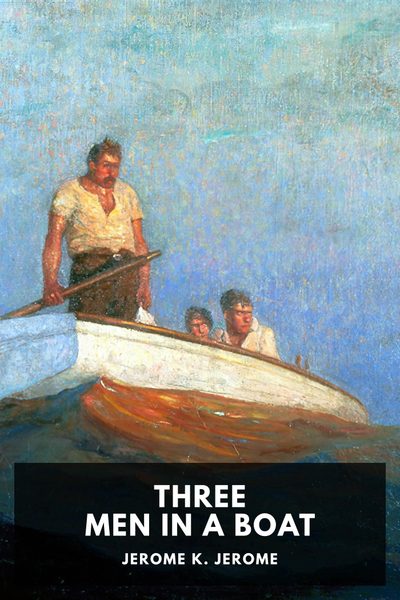
Трое в лодке, не считая собаки на английском: какой уровень нужен (B2)
Трое в лодке, не считая собаки, Jerome K. Jerome, 1889
- Слов
- 67 225
- Разных слов
- 5 142
- Редких слов
- 11%
- Слов в предложении
- 20.1
- Часов чтения
- 5.6
Новое слово будет встречаться почти в каждом абзаце.
Довольно сложно. Мы оцениваем «Трое в лодке, не считая собаки» на уровне B2: 11% из 67 225 слов не входят в 3000 самых частых, в предложении в среднем 20.1 слов, так что новое слово встретится почти в каждом абзаце. На чтение уйдёт около 5.6 ч.
Кому подойдёт
Читателям уровня B2, которые легко читают романы попроще и хотят расширить словарь. Читайте понемногу каждый день.
Комический рассказ о трёх друзьях и собаке в лодочном путешествии по Темзе. Предложения лёгкие, но юмор строится на преувеличении и британском сленге, так что некоторые шутки приходится перечитывать. Редкие слова про лодки и путешествия: scull, tow, punt, hamper, towline. Эпизоды в основном самостоятельные, поэтому книгу удобно читать короткими сессиями.
Редкие слова, которые повторяются
- scull35
- tow30
- pie22
- hamper21
- punt18
- towline18
- comic17
- hotel17
- tomb16
- goes15
- opposite15
- steer15
- trout15
- canvas14
- stroke14
- anybody13
- funny13
- steadily13
- thirty13
- abbey12
Фразовые глаголы, которые встретятся
- go on31
- get up29
- get out25
- sit down23
- get in18
- come in16
- come back15
- come out15
- go in15
- look at15
- go out14
- put up14
- give up13
- go for12
- come up11
Как начинается книга
Three invalids —Sufferings of George and Harris —A victim to one hundred and seven fatal maladies —Useful prescriptions —Cure for liver complaint in children —We agree that we are overworked, and need rest —A week on the rolling deep? —George suggests the River —Montmorency lodges an objection —Original motion carried by majority of three to one.
There were four of us —George, and William Samuel Harris, and myself, and Montmorency. We were sitting in my room, smoking, and talking about how bad we were —bad from a medical point of view I mean, of course.
We were all feeling seedy, and we were getting quite nervous about it. Harris said he felt such extraordinary fits of giddiness come over him at times, that he hardly knew what he was doing; and then George said that he had fits of giddiness too, and hardly knew what he was doing. With me, it was my liver that was out of order. I knew it was my liver that was out of order, because I had just been reading a patent liver-pill circular, in which were detailed the various symptoms by which a man could tell when his liver was out of order. I had them all.
It is a most extraordinary thing, but I never read a patent medicine advertisement without being impelled to the conclusion that I am suffering from the particular disease therein dealt with in its most virulent form. The diagnosis seems in every case to correspond exactly with all the sensations that I have ever felt.
I remember going to the British Museum one day to read up the treatment for some slight ailment of which I had a touch —hay fever, I fancy it was. I got down the book, and read all I came to read; and then, in an unthinking moment, I idly turned the leaves, and began to indolently study diseases, generally. I forget which was the first distemper I plunged into —some fearful, devastating scourge, I know —and, before I had glanced half down the list of “premonitory symptoms,” it was borne in upon me that I had fairly got it.
I sat for awhile, frozen with horror; and then, in the listlessness of despair, I again turned over the pages. I came to typhoid fever —read the symptoms —discovered that I had typhoid fever, must have had it for months without knowing it —wondered what else I had got; turned up St. Vitus’s Dance —found, as I expected, that I had that too —began to get interested in my case, and determined to sift it to the bottom, and so started alphabetically —read up ague, and learnt that I was sickening for it, and that the acute stage would commence in about another fortnight. Bright’s disease, I was relieved to find, I had only in a modified form, and, so far as that was concerned, I might live for years. Cholera I had, with severe complications; and diphtheria I seemed to have been born with. I plodded conscientiously through the twenty-six letters, and the only malady I could conclude I had not got was housemaid’s knee.
I felt rather hurt about this at first; it seemed somehow to be a sort of slight. Why hadn’t I got housemaid’s knee? Why this invidious reservation? After a while, however, less grasping feelings prevailed. I reflected that I had every other known malady in the pharmacology, and I grew less selfish, and determined to do without housemaid’s knee.
Вопросы и ответы
Подходит ли «Трое в лодке, не считая собаки» для изучающих английский?
Да, начиная с B2. На уровне ниже чтение будет медленным.
Какой уровень английского нужен для «Трое в лодке, не считая собаки»?
Примерно B2. Это наша оценка по двум вещам: доле слов вне 3000 самых частых и средней длине предложения (20.1 слов здесь). Старомодный стиль мы не измеряем.
Сколько времени уходит на «Трое в лодке, не считая собаки»?
67 225 слов, около 5.6 ч при средней скорости чтения. По 20 минут в день это около 17 дн.