Los buscadores de tesoros en inglés: ¿qué nivel necesitas? (A2)
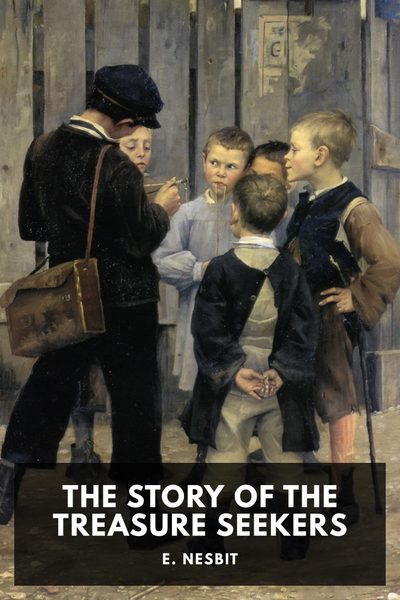
Los buscadores de tesoros, E. Nesbit, 1899
- Palabras
- 53.161
- Palabras distintas
- 3266
- Palabras poco frecuentes
- 10%
- Palabras por frase
- 15.6
- Horas de lectura
- 4.4
Pocas palabras poco frecuentes. Un buen primer libro.
No, Los buscadores de tesoros no es difícil. Es una lectura fácil de nivel A2: solo el 10% de sus 53.161 palabras queda fuera de las 3000 más comunes, las frases tienen de media 15.6 palabras y el libro lleva unas 4.4 horas.
A quién le va bien
Lectores de nivel A1 a A2 que quieren un primer libro de verdad en inglés y no les molesta mirar una palabra de vez en cuando.
Seis hermanos prueban un plan tras otro para devolver la riqueza a la familia, y uno de ellos cuenta la historia con mucho humor. Las frases son cortas y los diálogos naturales, así que se lee rápido. Las palabras poco frecuentes vienen del dinero y las travesuras: robber, editor, shilling, burglar, poetry. Algunas expresiones, como jolly y eh, suenan muy eduardianas, pero se repiten lo bastante como para aprenderlas.
Palabras poco frecuentes que vuelven una y otra vez
- robber74
- editor50
- bottle42
- jolly39
- shilling39
- poetry38
- burglar29
- eh29
- princess27
- wine25
- sovereign22
- kid21
- restore19
- bandit18
- penny18
- rod18
- hero16
- butcher15
- detective15
- especially15
Verbos con partícula que te vas a encontrar
- go on55
- sit down19
- come out18
- go down17
- go in17
- come in15
- come back14
- go out14
- come down13
- get up12
- put on12
- shut up12
- go away10
- make up9
- find out8
Cómo empieza
The Council of Ways and Means
This is the story of the different ways we looked for treasure, and I think when you have read it you will see that we were not lazy about the looking.
There are some things I must tell before I begin to tell about the treasure-seeking, because I have read books myself, and I know how beastly it is when a story begins, “ ‘Alas!’ said Hildegarde with a deep sigh, ‘we must look our last on this ancestral home’ ” —and then someone else says something —and you don’t know for pages and pages where the home is, or who Hildegarde is, or anything about it. Our ancestral home is in the Lewisham Road. It is semidetached and has a garden, not a large one. We are the Bastables. There are six of us besides Father. Our Mother is dead, and if you think we don’t care because I don’t tell you much about her you only show that you do not understand people at all. Dora is the eldest. Then Oswald —and then Dicky. Oswald won the Latin prize at his preparatory school —and Dicky is good at sums. Alice and Noël are twins: they are ten, and Horace Octavius is my youngest brother. It is one of us that tells this story —but I shall not tell you which: only at the very end perhaps I will. While the story is going on you may be trying to guess, only I bet you don’t.
It was Oswald who first thought of looking for treasure. Oswald often thinks of very interesting things. And directly he thought of it he did not keep it to himself, as some boys would have done, but he told the others, and said —
“I’ll tell you what, we must go and seek for treasure: it is always what you do to restore the fallen fortunes of your House.”
Dora said it was all very well. She often says that. She was trying to mend a large hole in one of Noël’s stockings. He tore it on a nail when we were playing shipwrecked mariners on top of the chicken-house the day H. O. fell off and cut his chin: he has the scar still. Dora is the only one of us who ever tries to mend anything. Alice tries to make things sometimes. Once she knitted a red scarf for Noël because his chest is delicate, but it was much wider at one end than the other, and he wouldn’t wear it. So we used it as a pennon, and it did very well, because most of our things are black or grey since Mother died; and scarlet was a nice change. Father does not like you to ask for new things. That was one way we had of knowing that the fortunes of the ancient House of Bastable were really fallen. Another way was that there was no more pocket-money —except a penny now and then to the little ones, and people did not come to dinner any more, like they used to, with pretty dresses, driving up in cabs —and the carpets got holes in them —and when the legs came off things they were not sent to be mended, and we gave up having the gardener except for the front garden, and not that very often. And the silver in the big oak plate-chest that is lined with green baize all went away to the shop to have the dents and scratches taken out of it, and it never came back. We think Father hadn’t enough money to pay the silver man for taking out the dents and scratches. The new spoons and forks were yellowy-white, and not so heavy as the old ones, and they never shone after the first day or two.
Preguntas frecuentes
¿Sirve Los buscadores de tesoros para aprender inglés?
Sí. Tiene pocas palabras raras, así que es un primer libro amable.
¿Qué nivel de inglés necesito para leer Los buscadores de tesoros?
Más o menos A2. Es nuestra estimación a partir de dos cosas: la proporción de palabras fuera de las 3000 más comunes y la longitud media de las frases (15.6 palabras aquí). No medimos el estilo antiguo.
¿Cuánto se tarda en leer Los buscadores de tesoros?
53.161 palabras, unas 4.4 horas a una velocidad media de lectura. A 20 minutos al día son unos 14 días.