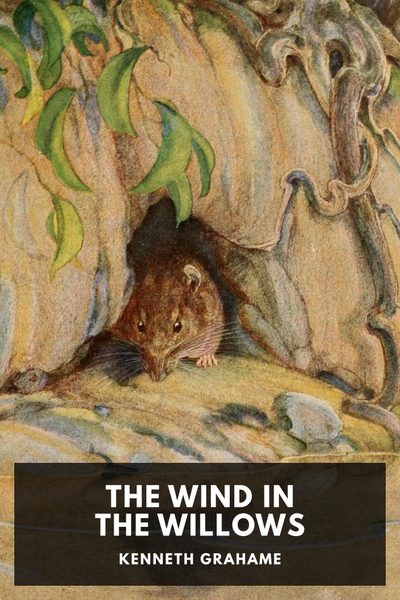
El viento en los sauces en inglés: ¿qué nivel necesitas? (B2)
El viento en los sauces, Kenneth Grahame, 1908
- Palabras
- 59.334
- Palabras distintas
- 5042
- Palabras poco frecuentes
- 14%
- Palabras por frase
- 18.6
- Horas de lectura
- 4.9
Espera una palabra nueva en casi cada párrafo.
Es bastante difícil. Calculamos El viento en los sauces en el nivel B2: el 14% de sus 59.334 palabras queda fuera de las 3000 más comunes, las frases tienen de media 18.6 palabras, así que verás una palabra nueva en casi cada párrafo. Se lee en unas 4.9 horas.
A quién le va bien
Lectores de nivel B2 que terminan novelas más sencillas sin problema y quieren ampliar vocabulario. Léelo en sesiones cortas cada día.
Una historia amable sobre un topo, una rata, un tejón y un sapo. El lenguaje es pulido y algo formal, con largos pasajes descriptivos sobre el río y el campo. Las palabras poco frecuentes vienen de la naturaleza y del transporte de otra época: toad, badger, barge, motorcar, presently. Los diálogos son fáciles, y las descripciones son donde irás más despacio.
Palabras poco frecuentes que vuelven una y otra vez
- toad453
- rat371
- badger161
- presently36
- em34
- motorcar33
- otter33
- barge30
- driver28
- weasel28
- cart25
- murmur24
- luncheon20
- washerwoman20
- gipsy19
- poop18
- banquet17
- weary17
- colour16
- fling16
Verbos con partícula que te vas a encontrar
- go on32
- sit down28
- come along17
- come back14
- come on12
- look at10
- sit up10
- take up10
- get out9
- get up9
- pick up9
- set off9
- come out7
- go off7
- put on7
Cómo empieza
The River Bank
The Mole had been working very hard all the morning, spring-cleaning his little home. First with brooms, then with dusters; then on ladders and steps and chairs, with a brush and a pail of whitewash; till he had dust in his throat and eyes, and splashes of whitewash all over his black fur, and an aching back and weary arms. Spring was moving in the air above and in the earth below and around him, penetrating even his dark and lowly little house with its spirit of divine discontent and longing. It was small wonder, then, that he suddenly flung down his brush on the floor, said, “Bother!” and “O blow!” and also “Hang spring-cleaning!” and bolted out of the house without even waiting to put on his coat. Something up above was calling him imperiously, and he made for the steep little tunnel which answered in his case to the gravelled carriage-drive owned by animals whose residences are nearer to the sun and air. So he scraped and scratched and scrabbled and scrooged, and then he scrooged again and scrabbled and scratched and scraped, working busily with his little paws and muttering to himself, “Up we go! Up we go!” till at last, pop! his snout came out into the sunlight and he found himself rolling in the warm grass of a great meadow.
“This is fine!” he said to himself. “This is better than whitewashing!” The sunshine struck hot on his fur, soft breezes caressed his heated brow, and after the seclusion of the cellarage he had lived in so long the carol of happy birds fell on his dulled hearing almost like a shout. Jumping off all his four legs at once, in the joy of living and the delight of spring without its cleaning, he pursued his way across the meadow till he reached the hedge on the further side.
“Hold up!” said an elderly rabbit at the gap. “Sixpence for the privilege of passing by the private road!” He was bowled over in an instant by the impatient and contemptuous Mole, who trotted along the side of the hedge chaffing the other rabbits as they peeped hurriedly from their holes to see what the row was about. “Onion-sauce! Onion-sauce!” he remarked jeeringly, and was gone before they could think of a thoroughly satisfactory reply. Then they all started grumbling at each other. “How stupid you are! Why didn’t you tell him —” “Well, why didn’t you say —” “You might have reminded him —” and so on, in the usual way; but, of course, it was then much too late, as is always the case.
It all seemed too good to be true. Hither and thither through the meadows he rambled busily, along the hedgerows, across the copses, finding everywhere birds building, flowers budding, leaves thrusting —everything happy, and progressive, and occupied. And instead of having an uneasy conscience pricking him and whispering “whitewash!” he somehow could only feel how jolly it was to be the only idle dog among all these busy citizens. After all, the best part of a holiday is perhaps not so much to be resting yourself, as to see all the other fellows busy working.
He thought his happiness was complete when, as he meandered aimlessly along, suddenly he stood by the edge of a full-fed river. Never in his life had he seen a river before —this sleek, sinuous, full-bodied animal, chasing and chuckling, gripping things with a gurgle and leaving them with a laugh, to fling itself on fresh playmates that shook themselves free, and were caught and held again.
Preguntas frecuentes
¿Sirve El viento en los sauces para aprender inglés?
Sí, a partir de B2. Por debajo se hará lento.
¿Qué nivel de inglés necesito para leer El viento en los sauces?
Más o menos B2. Es nuestra estimación a partir de dos cosas: la proporción de palabras fuera de las 3000 más comunes y la longitud media de las frases (18.6 palabras aquí). No medimos el estilo antiguo.
¿Cuánto se tarda en leer El viento en los sauces?
59.334 palabras, unas 4.9 horas a una velocidad media de lectura. A 20 minutos al día son unos 15 días.